
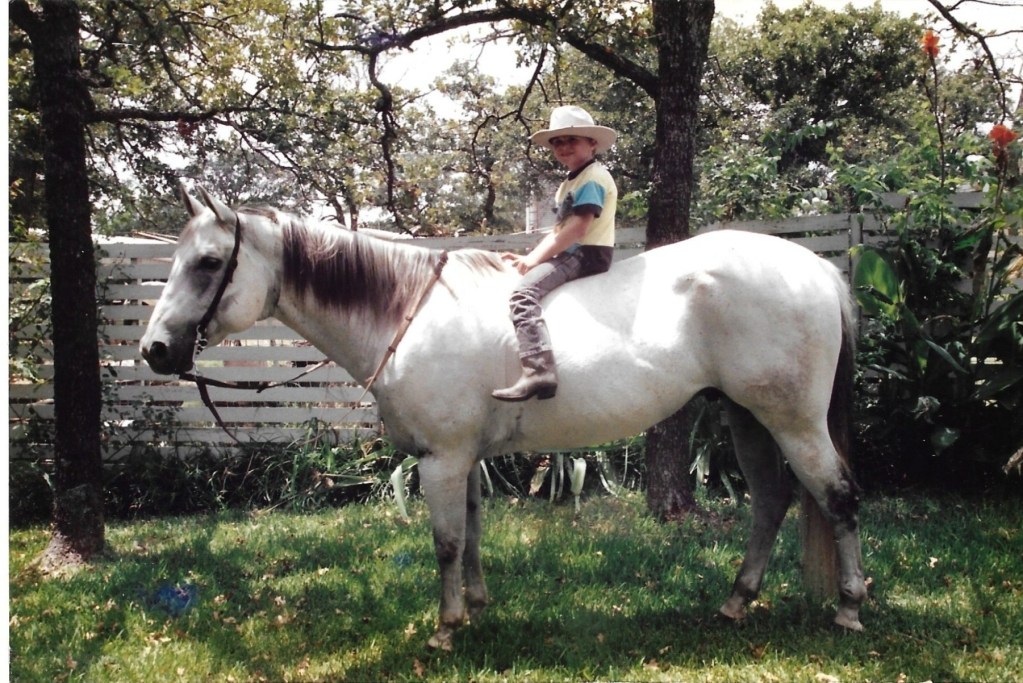
After selling my horse Missy, I spent the next five years taking horseback riding lessons, mostly English disciplines. Two months after my son, Andy, was born, my husband’s job moved to Connecticut, where we settled in the city of Norwalk. Jeff’s brother and our sister-in-law lived in Manhattan and soon the excitement in NYC became our playground. In Connecticut I found an adorable little stable and enrolled into riding lessons. I also rented horses to ride along some marvelous trails. One of my very favorite being the riding the trails through Central Park in NYC.
From my very first riding lesson, my method of fluid, relaxed riding was suddenly restrained. I was taught to keep my toes in unnatural forward positions, My seat had to be perched so that I was sitting straight up on my pelvis bones. Thanks to many years studying ballet, I was able to contort my body into positions that please my instructors, but thwarted relaxation into, tight muscles, which eliminated the fluidity that Missy had taught me when I learned to ride her bareback.
At that time in my life, I didn’t perceive myself as an excellent rider. There was so much that I knew I had to learn. The hunger to become an excellent, accomplished rider, fueled my determination to persevere and continue on with my lessons.
One of the most interesting aspects to horsemanship in Ohio and Indiana versus riding out east, was the different opinions regarding riding positions and the phraseology. I also discovered that the mid-west trainers were much more layback and approachable, whereas out east, they tended to be aloof, stuffy and unapproachable. Years of studying classical ballet, had already seasoned me to the world of stuffy and unapproachable.
The personal goal that has always fueled my passion for horses is my interaction with them. This interaction starts with the groundwork and transitions into your riding. The showring had never been my ultimate goal. Even though I understand the joys in competing and engaging with others and their horses in the mutual goal to win a blue ribbon. I greatly respect all of the years of training and hard work and money that goes into a performance horse that only shines with an equally skilled rider. But I simply wasn’t interested! What did interest me was achieving a close, almost telepathic bond with horses, like the horse/human bonds and relationship that I had read about in classic horse stories when I was a kid.
As others around me verbalized the need to use force to get a horse to respond in a certain way, and raised their voices against handling foals too much, or horses in general for that matter, because you might spoil them. I was secretly summoning horses into my personal space, because physical closeness to them, the delicious smell of their lovely coats and intelligence in their expressive eyes was something I desperately desired to be close to
However, my eastern riding escapades quickly came to an abrupt halt, when only four months after moving to Connecticut I, once again, became pregnant. Almost immediately the pregnancy became high risk. I prematurely gave birth to my daughter, Juliann (Juli), and began my journey as a parent raising a child with special needs—cerebral palsy. Three years later my family moved to the DFW area in Texas, where roots were established, and my children grew up.
Immediately, I enrolled Juli into our school district’s early childhood education program. One of the school’s physical therapists suggested that I look into a “hippotherapy” program, which used horses to help people with special needs develop better muscle control. I firsthand understood the emotional support equine therapy provides, but hippotherapy taught me about the physical benefits of riding a horse.
Hippotherapy, or physical therapy on horseback, uses a horse’s movements to help develop a patient’s balance and coordination, as well as increase their muscle strength. When a horse is walking, the movement mimics the same physical patterns of a person’s walk. Every step a horse takes transfers movement to the legs and pelvis of that person. In addition, riding a horse can help a person find their center of balance.
The goal is to stimulate the muscles of the individual, using the rhythmic gait of a horse’s walk, so that over time, the repetitive movement will eventually imprint to the individual’s “muscle memory.” Muscle memory happens when any movement is repeated over time such as the disciplines of swimming, dancing, creating art, playing a musical instrument, sports and learning to walk, our brains form a memory for that activity. And as time progresses, with plenty of practice, an individual is eventually able to perform that activity effortlessly.
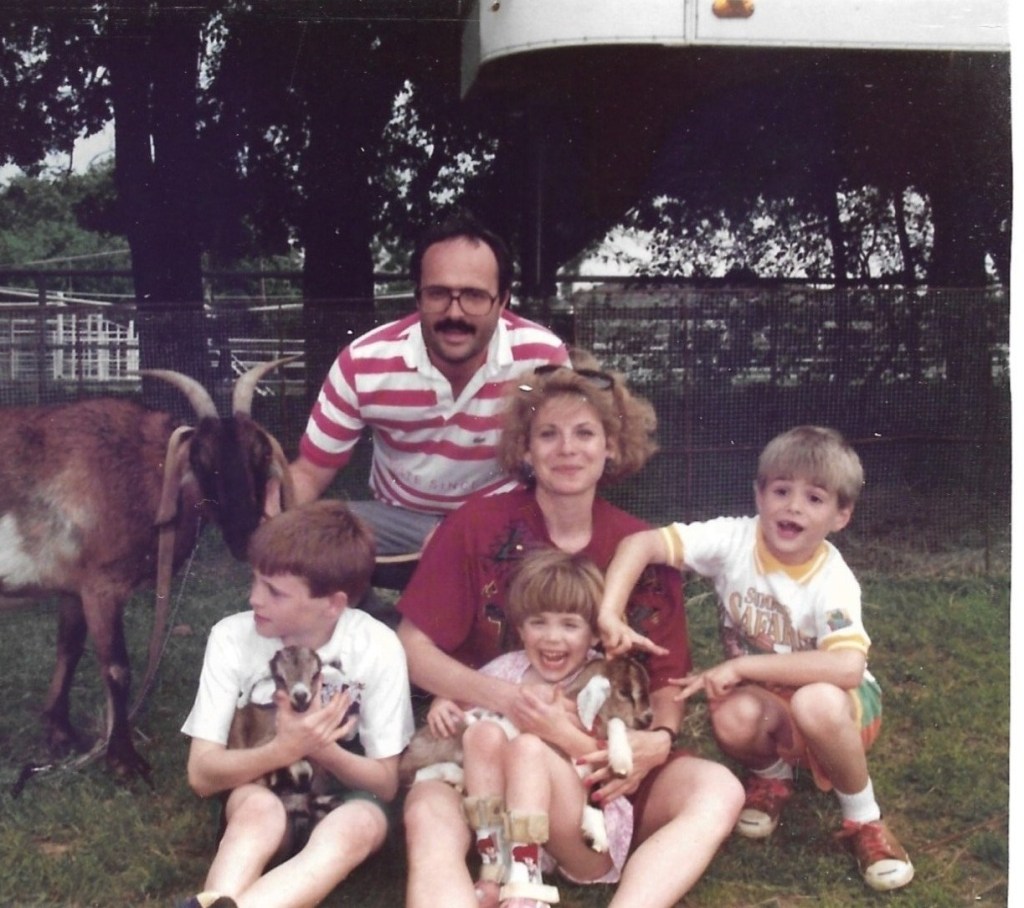
Juli’s hippotherapy was scheduled to take place in a lovely stable, in Keller, Texas, called Rocky Top Ranch. Not only did Juli take to riding horses like a duck to water, but my boys also loved it too. Rocky Top became our playground with its wonderful pastures, annual offspring of foals, haylofts, baby goats, peacocks, a pond and a huge sow named Sarah Beth. Often the kids’ friends tagged along. For me, being once again submerged in the delicious world of horses became my respite from work as a fitness professional and the stresses of raising children who all had special needs ranging from learning disabilities to very gifted.
If I were to guess, I would say that there were probably over 100 horses on the ranch, not counting the foals. Some of the horses were privately owned by boarders, many of whom became my friends. Others were used for hippotherapy, there was a handsome palomino stallion named, Keno and broodmares who produced 40 to 50 foals that were born on the ranch every spring. My kids and I will never forget Paco, a friendly boy who always popped his bottom lip out of boredom. Rocky Top was not just a therapy program, is was a fully functional equestrian facility.
Shortly after the kids and I became part of the ranch, I began to step in and help halter train some of the foals. Working with these babies really sharpened my equestrian knowledge and skills, mainly kept me on my toes because of their tendency to spontaneously combust. One afternoon I asked the owner if he had a horse that needed exercise ride and if I could ride it. That’s when I was introduced to my next horse, a beautiful gray Quarter Horse, gelding named TJ.
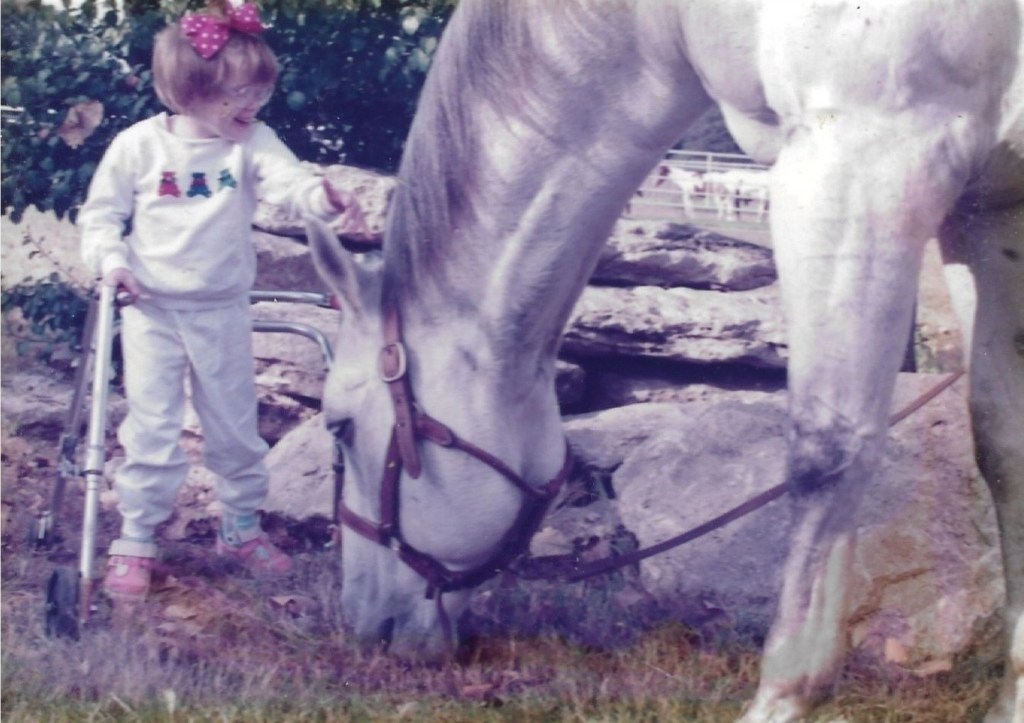
TJ was 16 years old, about 15.1 hands and the kids and I absolutely adored him. The stable had tried to use him for the therapy program, but TJ didn’t have the disposition for it. He was full of personality and would literally eat anything including…his own poop. At the time Juliann was using a walker, and he loved to grasp it with his teeth and carry it around the barn. He also took every opportunity to nip. I had to watch him like a hawk; in turn he would watch me and with a twinkle in his eye, and if I became distracted, he’d nail me, looking extremely pleased with himself afterward. He was also my introduction to a cribber.
Cribbing, is when a horse takes hold of a surface with its teeth and pulls back while taking in air. It is the most common stereotypical behavior in horses. Cribbing can also be deadly, because it interferes with a horse’s normal gut action, which in itself is a delicate balance. Some horses repeat this behavior for hours. In order to prevent this behavior in horses a special “cribbing collar” is used. The collar is fastened around the top of a horse’s poll, just behind their ears and under their neck close to the horse’s head.
At this point I had decided to give up riding lessons. I didn’t have time for them anyway. Instead, I returned to my fluid form of riding that Missy had taught me. I often rode TJ bareback and enjoyed many afternoons and evenings, not just riding, but brushing and interacting with him. He had a layback personality, meaning he wasn’t fazed by much, which also made him a perfect mount for the kids. In turn, they often rode him.
TJ had spent most of his adult life performing in the show ring and he had collected significant points in “Western Pleasure.” He was very familiar with a large variety of stimuli which made him “bullet proof,” or a dependable mount. He was also the kind of horse that you had to keep a firm leg on in order to keep him moving forward. And if he suspected that you didn’t know what you were doing while riding him, he tried every trick in the book to take advantage of the situation.
One truth I have learned while working with horses, is to always expect the unexpected. Particularly when a horse eating monster, such as a plastic bag carried by the wind, or a misplaced bucket, triggers their inner “flight” instinct. Horses are flight animals which means that their natural response to frightful situations is to run away, just like a rabbit or deer does when they’re afraid. The key to handling this “flight” instinct, which can easily turn dangerous, even deadly, is to teach your horse how to respond to their fear in ways other than bolting. This takes time, but it’s well worth the practice.
As I worked with TJ, I was also beginning to learn two essential lessons that have helped me in more situations than I can count and they are; one, teach your horse that you are a “safe haven;” two, the more frantic situation becomes, the calmer you need to be.
I taught TJ and all of my future horses, that I was a “safe haven,” which meant that I was a trustworthy and gentle handler, that they could turn to when they were afraid or when they escaped from their stalls. I achieved this trust with a variety of interactions other than riding. Repetition and consistency were very important to my success, followed by maintaining the rewards my horse’s came to expect. One of the tricks up my sleeve was playing the “halter game.”
So often, on the days I went to ride, TJ was out in the pasture grazing. He would see me approaching him with the halter and wouldn’t let me within 10 feet of him. Chasing after him was not only frustrating but equally exhausting. Then I began playing a game in his stall where I slipped the halter on and gave him a treat. I repeated slipping on and taking off the halter, until he started to get the hang of it. Then I began then I took the halter game to the open pasture. Sometimes I spent time with him, scratching all the itchy places a horse can’t reach, leading him around, and always releasing him to roam free. Eventually, TJ would come to me when he saw me approaching.
A common mistake I have seen throughout the years is when an owner reprimands their horse when it escapes from its stall, a pasture or even a handler. Instead of hitting the horse or scolding it, stay calm, and praise your horse when it returns to you. The use of treats really help to reinforce this! By teaching your horse that you are always a safe haven they learn that they can return to you and be safe.
One of the most important safety lessons I learned was the need to stay calm when a horse to panics. This is a conditioned skill that I have practiced over the passage of many years, am still learning and one that also came in handy while I was raising my kids.
Let me interject here, of course, a horse’s bad behavior needs to be addressed. I’m a firm believer in establishing method’s that discipline and teach a horse, you can’t do that. Horse’s need to be well mannered. Natural Horsemanship training methods taught me how to achieve a desired behavior without hitting a horse.
As my boys grew, they were diagnosed with what was then a new medical term called ADHD. At the time, many medical professional dismissed ADHD as nonsensical. But as I read about this condition with the goal of helping my children, I also learned about myself. Suddenly my own childhood experiences in school made perfect sense. I too have ADHD and am also dyslexic. This was an eureka moment for me which left me thinking, no wonder!
When I owned TJ, I was functioning as a full-time mom, raising my kids by myself, to support my husband’s successful climb up the corporate ladder. Almost every week his work took him out-of-town, while I raised our children. TJ and my other horses became my means of comfort, my stress relief and even though I was working as a fitness professional teaching 4-5 aerobic classes 5 times a week, horseback riding was and still is, my favorite form of exercise. Throughout our marriage, my husband has always lovingly understood this need in me.
One day, I friend of mine asked my if I had a horse she could ride. With TJ in mind, I said yes. I knew my old boy would be the perfect fit. I asked the owner at Rocky Top if he had another horse that needed exercise that I could ride with my friend. He did. That’s when a 5-year-old, Quarter Horse mare named Rose, entered my life. At the end of our first ride, I knew that I absolutely had to own her.