
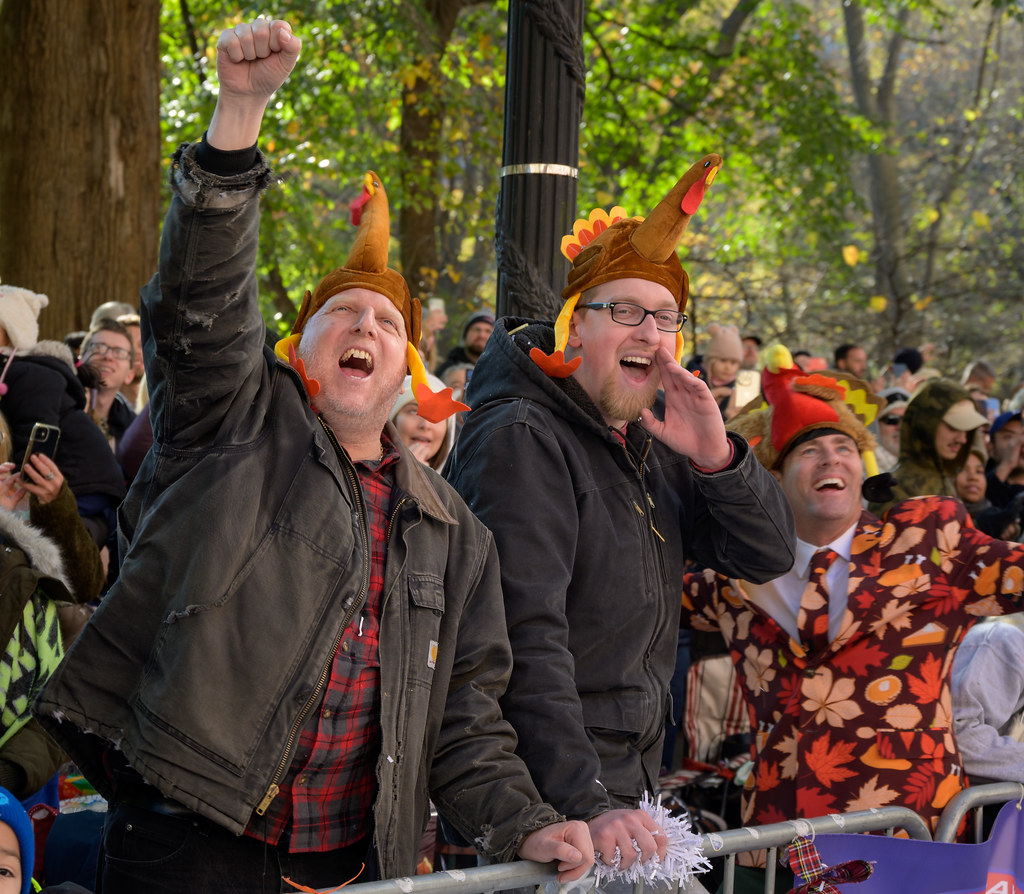
For 100 years, Americans have watched the Macy’s Thanksgiving Day Parade as part of their Thanksgiving Day tradition. As history has unfolded and the country encountered periods of growth, decline, war and peace, the parade has consistently served as a joyous reprieve for millions of people.
It began in New York City in 1924, when employees from the famous Macy’s Department store decided to celebrate Thanksgiving Day with the European custom of a parade. Most of the employees were first-generation immigrants. Dressing up in costumes portraying clowns, cowboys, knights and sheiks, they marched the streets of Manhattan accompanied by professional musicians and animals from the Central Park Zoo. The Parade began at 145th Street with an audience estimated at a quarter of a million people and ended at 34th Street, where Macy’s Department Store still operates today. The first Macy’s Thanksgiving Day Parade was a huge success, and it continued growing until eventually the entire nation was part of the festivities.
The most distinctive feature of the parade is the large, helium ballons. The balloons made their first appearance in 1927, in the form of the cartoon character Felix the Car. For many years, the balloons were released into the air where they often floated for several day. People searched the sies in hope of spotting one or retrieving a fallen balloon and exchanging it for a prize.
The stock market crash of 1929 threw America into the Great Depression. In 1933, close to 13 million people were out of work and many other were employed only part time. More that 750,000 farmers lost their land, and hundreds of thousands of people lost their life savings as a result of bank failures. The Macy’s Thanksgiving Day Parade provided a brief respite to the stark realities of the Depression, thrilling children with balloons portraying beloved Walt Disney characters and providing adults with free entertainment. Thanksgiving Day, 1934, crowds numbering more than 1 million people lined the curbs and sidewalks of New York City to watch the parade. Millions of others listened by way of radio broadcasts.
The Japanese bombed Pearl Harber on Dec. 7, 1941, and the United States entered World War II. The next year, the Macy’s Thanksgiving Day Parade came to an abrupt halt. The U.S. government needed helium and rubber for war-related supplies. With an estimated 15 million men and 338,000 women serving in the Armed Forces, Americans did not have much to celebrate. The Japanese surrendered on Sept. 2, 1945, one month after the United States bombed Hiroshima. That November, the Macy’s Thanksgiving Day Parade resumed, and for the first time, New Yorkers had the option of watching the parade on television.
During the 1950’s, the United States experienced a period of rapid economic growth. Instead of listening to the parade in radio broadcasts, the Nation watched on television. Celebrities began making live appearances. Some of the first celebrities to appear included Sid Caesar and Danny Kaye. The economic increase continued into the 1960’s. In 1961, the large balloon of Bullwinkle the Moose made its first appearance. Children eagerly waited for a glimpse of other favorite cartoon characters, such as Underdog.
The Macy’s Thanksgiving Day Parade has never been canceled due to bad weather. Except for World War II, the parade has always marched on, regardless of rain, sleet, or snow. Once in 1971, the large balloons were withdrawn, because of strong winds that rendered them unsafe. Television networks supplemented to lass of the balloons be interjecting clips of balloons from the previous year.
Perhaps the most anticipated moment of the parade is the arrival of Santa Claus to Herald Square at 34th Street and Broadway. His appearance always concludes the parade, the only exception was in 1932, when Santa actually led the parade. Santa’s arrival also signals the beginning of the Christmas season. When President John F. Kennedy was assassinated in 1963, less that a week before Thanksgiving Day, the parade proceeded as scheduled, placing the needs of the children ahead of a Nation in mourning. This November, as the nation celebrates Thanksgiving, many Americans will again celebrate the freedom and joy of the parade.