For three years now, I’ve driven passed this tree without giving it a second thought. Then one winter when it was freezing cold, when all the tree branches were bare, this tree caught my attention for the first time. I began to notice this tree in relation to the scattering of other trees growing around it. Curious, and with this article in mind, I parked my car and got out for a closer look.
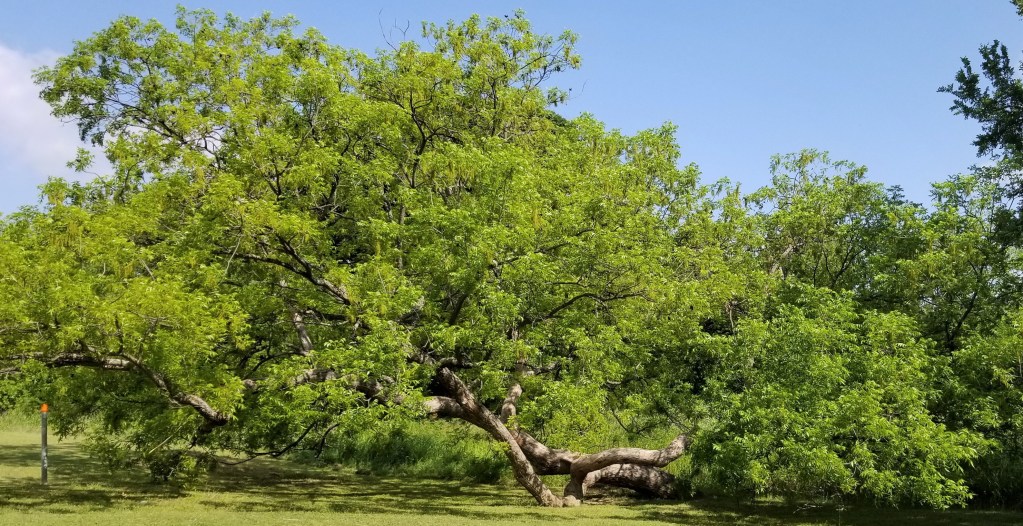
I discovered that all though this tree is “different” in appearance compared to the majority of tree’s growing in this park, it is also perfectly healthy. In addition, it’s a fruitful contributor. It produces oxygen and provides homes for wildlife. It’s also pretty to look at. In fact, based upon the condition of some of the other trees growing around it, this tree is a top performer.

It’s lower branches are gnarled and growing close to the ground. One even extends along the ground for several feet. This tree doesn’t have the physical form we’re used to seeing. It’s different. It’s unique, yet despite looking different, this tree performs the same tasks all trees were created to perform and its doing its job well.
This tree has determination to survive! This is what drew me to it in the first place. Minus its spread of lovely leaves, I can see its struggle. I hear its story!
During the sapling stages of its life something bent this tree over, pressing it down. But instead of succumbing it the pressure, it continued to grow, becoming stronger and stronger. Eventually its branches became so thick and strong, it could sustain the weight of adults and children. While sitting on one of its low branches, I feel the desire to explore, thinking how much fun this tree would be to climb.

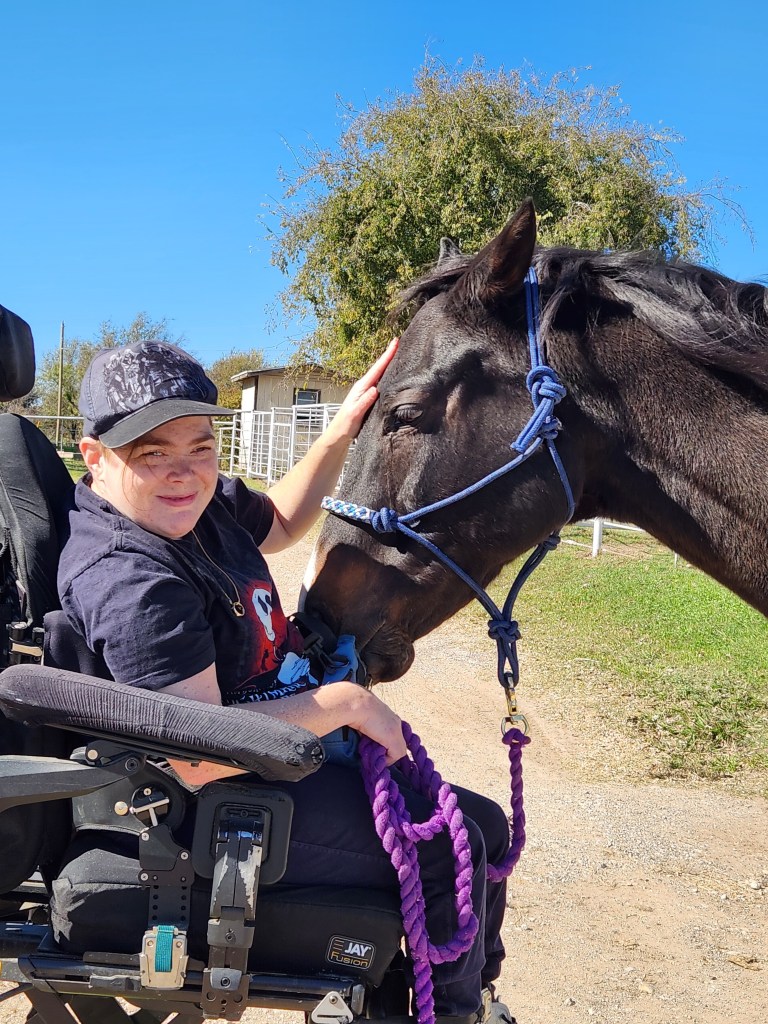
I’ve seen others sitting on the lower branches too. Enjoying a shady rest from the scalding Texas heat. Sometimes they pause long enough to eat a snack, evidenced by the discarded, plastic cup seen in one of the pictures. Frankly, this gnarled, odd-looking tree seems to be everyone’s favorite because of its accessibility, the comfort it provides, its strength, and uniqueness. This tree reminds me of my daughter, Juliann.
If you’re reading this article… I thank you! I’m also guessing that most-likely you are a mom to a special needs child. Simply because I have been told by many medical professionals that 99% of the children they see are accompanied by their moms. But that was over twenty years ago, so, if you’re a dad, I thank you even more, for the reason stated above and ask that you not be offended if it seems like I’m only addressing women. I’m not. It’s only because my story is delivered from a woman’s perspective.
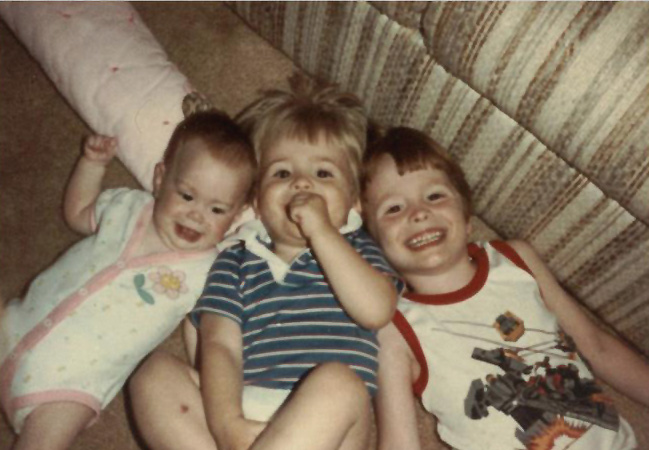
As I began writing about my life and motherhood, a sudden flood of memories laced with lessons I learned, inundated my brain. Lessons, that years ago I felt strong inclinations to share with other parents who might be facing similar circumstances as mine. My children’s needs ranged from physically handicapped, to gifted, with both of my boys having extreme ADD with hyperactivity.
My husband and I were also adoptive, foster parents, which opened our eyes to the effects of physical and emotional abuse in children and adults. In addition, I personally, have struggled my whole life with ADHD and Dyslexia.

My hope and purpose in writing this story is to offer as much encouragement as I can to other parents facing similar circumstances. To impress upon you that you are not alone in raising your special child! You are not alone in your emotions, your inner, unspoken thoughts, your isolation and the immensity of your load! Let me address your unspoken thought first…
Years ago, a counselor told me that feelings are just that—only feelings! They are neither good nor bad, it’s what you do with your feelings (how you act upon them) that matters. In a nutshell, you are not a bad person or parent because of the way you feel. And if you’re just beginning your journey down this road called special needs and can’t see the light at the end of the tunnel… I’m here to tell you, that light is there!

When I was first struck with the realization my child had significant physical differences, I felt as if I had crossed an invisible line, into an unknown world that was extremely frightening. No one else in my life was raising a child with special needs. I quickly learned that my friends and family members couldn’t begin to comprehend what I was facing.
Overwhelmed, and alone, I felt as if I was standing at the bottom of a huge mountain staring up at the top. I knew I had to climb to the summit but seriously questioned my abilities to so. Two conflicting emotions tormented me. One, I loved my baby with all of my heart. The second, and real zinger; I absolutely didn’t want to face raising a child that with special needs and a future that was unknown. In the beginning, I wished the years away, wanting to be instantly transported to the summit of that mountain. That place where all of the questions and unknowns were revealed.
My journey began with a seriously complicated pregnancy only two months after my second son, Andrew, was born. My complications resulted in an early amniocentesis, which revealed that my baby was a little girl. My husband and I were thrilled! We had our daughter and we named her Juliann (Juli). I continued to have complications throughout the pregnancy which climaxed two months before Juli’s approximate birth date. I was hospitalized, which was very difficult because I had two little boys at home. Finally, two months before Juli’s due date, she was delivered.
After raising my two boys, Chris and Andy who had just turned one, I immediately suspected that something was very wrong with Juli’s physical development which was severely delayed. Almost a year after she was born the diagnosis came—cerebral palsy. My head swam the moment I heard the words. In an instant I was propelled, for the rest of my life, into this world labeled handicapped. There was no way to escape, no way to determine the extent of Juli’s disability nor whether or not her cognitive skills were affected. She was a little bundle of mystery and the love of my heart.
Still, I did not want to raise a physically handicapped child! I can say that now but was deeply ashamed of this secret, inner truth that I never shared with anyone for several decades.
Interestingly enough, daughter’s physical differences opened my eyes to how prejudice a person I really was. As a child, growing up in the latter years of segregation I never understood social prejudice. I was also submerged in the arts, my family a collection of professional artists, musicians, my mom an award-winning singer and actor, dad a television and radio broadcaster, all within Cleveland, Ohio where I am from. My artistic family and my own endeavors as a child actress and ballerina had also taught me to not to judge someone else’s lifestyle. But the moment the word handicapped was attached to my life! I ashamed to say, that was a different story!

Accepting my new state of being did not happen overnight. It was a process of multiple steps that continued throughout Juliann’s childhood. The beginning step was the hardest regarding acceptance that Juli needs would be different. My submission began while holding her tiny body close, kissing her infant hands, singing her songs, realizing I would do anything to keep my baby safe. Her needs took dominance over mine, and even though I didn’t want to manage cerebral palsy, I knew that I would do anything I had to for my daughter.
Immediately following Juliann’s diagnosis, she had further testing to give us a better understanding of her specific, physical needs. These tests became my second step. For the next twenty years Juli and I would have multiple doctor appointments, tests, surgery, equipment purchases, the first being form adjusting highchairs, walkers, wheelchairs, scooters and standers to stretch her hamstring muscles, as well as weekly occupational and physical therapy sessions. Just before she turned two, Juli had to wear glasses and an eye patch. It broke my heart, making her do this. Not just because she hated them, but because I hated covering up her adorable face. However, this treatment turned out to be excellent! By the time Juli was in the fourth grade she didn’t need to wear glasses at all.
At five years old Juli underwent a serious operation called a Dorsal Rhizotomy, which resulted in the severing over half the nerves in her lower body. Lifelong complications have resulted from that surgery, leaving me riddled with guilt wondering if I had made the right decision, despite an extensive team of physicians at Dallas Medical Center telling me this was her best option. We were part of an experiment, and I have since learned that the procedure is no longer done.
Throughout most of her childhood, Juli wore braces that wrapped around her feet supporting her legs, running up to her knees. As she grew, we had to have new braces regularly made. When she turned twelve, I supported her decision not to wear them anymore and to stop using the stander, which she hated. Next came the purchase of her first, motorized wheelchair, which meant purchasing a van with a wheelchair lift.
Before going forward, let me just say, that with each new step regarding Juliann’s development and physical needs, I went through a process or cycle of emotions. Here’s an example of what I mean, using the purchase of our first van with a wheelchair lift.
For some reason buying that van was, for me, the straw that broke the camel’s back. I hated it! It was a bulky huge vehicle and driving it frightened me. In fact, Chris named it Europe, because of its size. But the van was a necessary piece of equipment need for our entire family—for Juli.
Here’s the example of the process I went through:
1. Knowing that the van is necessary
2. Angry that the van is necessary
3. Purchasing the van
4. Angry that I absolutely had to learn how to drive the van
5. Mastering my driving skills (although Juli and her brothers endured (and still endure) bumps over curbs and the denting of quite a few handicapped signs when I park the van.
6. Acceptance (and may I add that we are getting ready to purchase our 3rd van!)
Whether it was the need for glasses, braces, surgery, medications, walkers, ect., I went through this cycle. Sometimes several times over a span of several years, before finally reaching acceptance. I’ve learned that this cycle is similar to the cycle a person experiences when dealing with grief; you experience, Denial—Isolation—Anger—Depression—Acceptance.
Juli’s physical and occupational therapist at her elementary school connected me with the most caring, heartfelt people, who not only encouraged her, but came to love her. These people were an essential source of support and information for me. They made my journey less frightening and steered me in the right direction, sometimes urging me to take action for events (such as SSI benefits) that would take place years in advance.
When Julu left the nurturing care of elementary school, to enter a far more demanding environment of middle school, she wasn’t prepared for the necessity of independence. Also, she had a difficult time connecting with special education staff. I took her out of the “heat,” and homeschooled her.
Homeschooling was something I had been thinking about doing for about four years, but didn’t have the nerve! But honestly, the experience in most ways was wonderful. The only drawback was I lost my social life because my mornings were immersed in the kids’ education; my afternoons booked driving them around to their specific activities; music lessons, sport practices and games; computer and speech classes, and theater productions my son Andy was in. And I found myself falling into an exhausted heap in the evenings.
Within a matter of two months after I pulled Juli from the public school, one by one the boys asked me to homeschool them too! Thankfully, the resources I needed were easily accessible. My children didn’t miss out on any activities or interaction with other kids their age. Lessons that I couldn’t teach such as advanced math concepts and chemistry; the kids learned through video programs that I purchased. Today there’s a rich supply of available homeschooling programs online.
When it was time for Juliann to enter high school, she and Andy both asked to be mainstreamed back into our public school system. (Chris had graduated from homeschooling and joined the Air Force as a Mandarin Chinese linguist.) During Juliann’s senior year, she spent her afternoons at a collage close to our home, working on a degree in graphic design. By the time she graduated from high school, making the dean’s and honor roll lists, she knew the college campus well.

At this point Juli was handling herself on her own. She graduated from her associates degree and moved to live independently in Dallas to pursue a Batchelor of Arts degree, also in graphic design. She maintained her honor roll, dean’s list status with both degrees. Yet, to our shock, even with an outstanding portfolio and honorary status, job hunting and social discrimination met all of us head on.
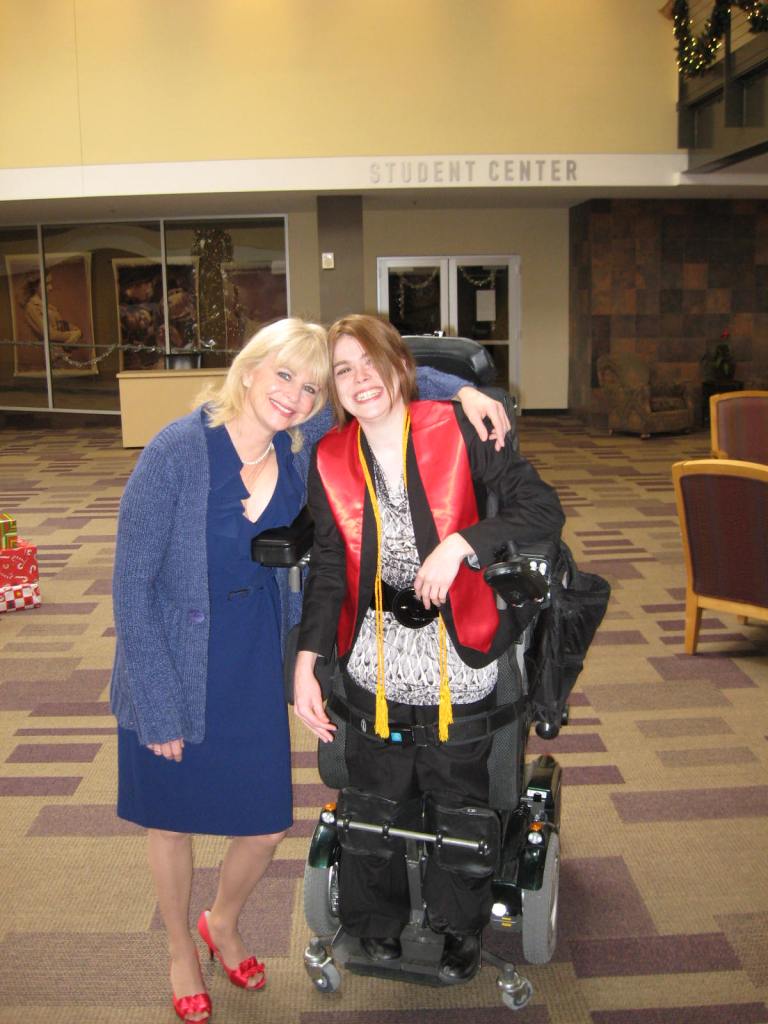
The most prominent issue was when Jeff drove her to a place for an interview and there were no entrances for a wheelchair. We discovered that potential employers were drawn to her stellar website and portfolio, however, and there’s no other way to say it—they were repulsed by the wheelchair. The moment they set eyes on Juli, even though she was well presented, and came with stellar recommendations, they changed their minds about hiring her.
The worst instance, that still make me upset, was the company that actually hired her based on her work. They asked Juli to get a drug test, then come to the office so she could meet her new coworkers. I drove Juli to the facility they recommended for the test. She looked beautiful, happiness and joy radiating from her face. Both of us were very excited as I drove her to the office, dropped the wheelchair ramp on the van, and sent her on her way, feeling great joy at the fulfillment of so many of Juli’s accomplishments.
However, moments later, Juli swiftly returned to the van. Red faced and on the edge of tears, she told me to quickly load her and get the hell away from that business.
What happened; as she entered the business, she was greeted by shocked faces. The men and woman didn’t realize that they had hired a woman in a wheelchair. Instantly they huddled in a corner, talking about Juli, glancing her way. Juli knew that they were talking about her and felt immediate shame. Finally, one of them walked up to Juli and told her there had been a grave mistake and they couldn’t hire her after all.
I sat in the van seething, fighting the strong desire to go into this place and slap American Disability Act in their face. Juli beseeched me not too. Understanding her need to get away from those people, I drove away. Sometimes you simply have to walk in forgiveness.
Now that Juliann is an adult, my husband, Chris and I are constantly on call, concerned about her safety. Three times Juli was hit by a car, as she was crossing a busy Dallas street to access the train station home. Amazingly, by the grace of God, she was unharmed, however, her wheelchair was totaled. One woman didn’t see her, ran a red light and send both Juli and her chair to the ground.
Occasionally her wheelchair breaks down! Leaving her stranded in Dallas (as well as defenseless). There are also the times when she’s waiting for the train, and a creepy person is too close. She calls us, and one of us stays of the phone with her until she’s safely on the train heading home. Home and my husband and I are an hour away from Dallas.
Then there was the time when she was on her way to school, and at the train station, a homeless man tried to pull her from her wheelchair, stating he was going to throw her in the street and kill her. But that’s a story for another time.
Jeff and I gave her advice and watched her positively worked with the Dallas DART system to control the homeless people, and drug addicts living in elevators that she and some of her coworkers must access every day. The process took several months. Jeff and I supported her at a meeting with the DART council, to thank them for the changes they worked earnestly to fix. This all happened in the wake of Covid 19.
Today, Juliann is 39 years old. She eventually found a wonderful job with Bank of American and after almost ten years still works with the outstanding company. Home for her is now close to ours. The drawback is she travels has to travel an hour commute (both ways) to get to work in Dallas. She is happy and although Bank of America didn’t hire her for graphic design, they have learned about of her talent in graphic design. Just before covid, Juli was given an artist’s computer and special cubby hole where she can work on graphic projects the company has been giving her.

As I look back upon my children’s upbringing, there are so many things I would like to have done differently. But I have to remind myself, that, at the time… I did the very best I could, with the abilities I was given and the tools that I possessed. That’s all any of us can do really, our best.As parents, especially women, we need to remember to take care of ourselves, the same way we take care of our children! A little fact that gets brushed under the carpet while juggling our family and work life (I also worked while raising my kids). An important lesson that I learned was that I couldn’t give to my family what I myself didn’t have to give. In other words, if I didn’t have patience when handling my kids, my kids in turn were impatient.
In Texas, the foster care system understands the importance of this need for rest. So much so, that they pay for parents to take short, overnight respites away from their house and children. I understand that leaving for the night isn’t an option for some people, finances and childcare being the main reasons. Still, everyone needs a break, especially if your raising children with special needs. Find the time and make it a priority. Search the internet for creative ideas. Most importantly, learn to discipline yourself concerning these times! Meaning don’t talk about or mull over in your mind, your children’s issues. This time is for you and your partner! Remember, even Jesus sought moments of solitude and rest.